

Most AI demos look great.
A chatbot summarises a policy. A model explains a control. Someone asks a question about ISO 27001, and the answer appears instantly.
Then the enterprise questions begin.
Where did the data go? Which model processed it? Was the prompt logged? Can we prove who had access? Can the AI only read data, or can it also change things? What happens when the compliance team wants to use AI, but legal, security, and IT have already approved a different AI setup?
That is where many AI features break down. Not because the model is bad, but because the architecture is wrong for enterprise use.
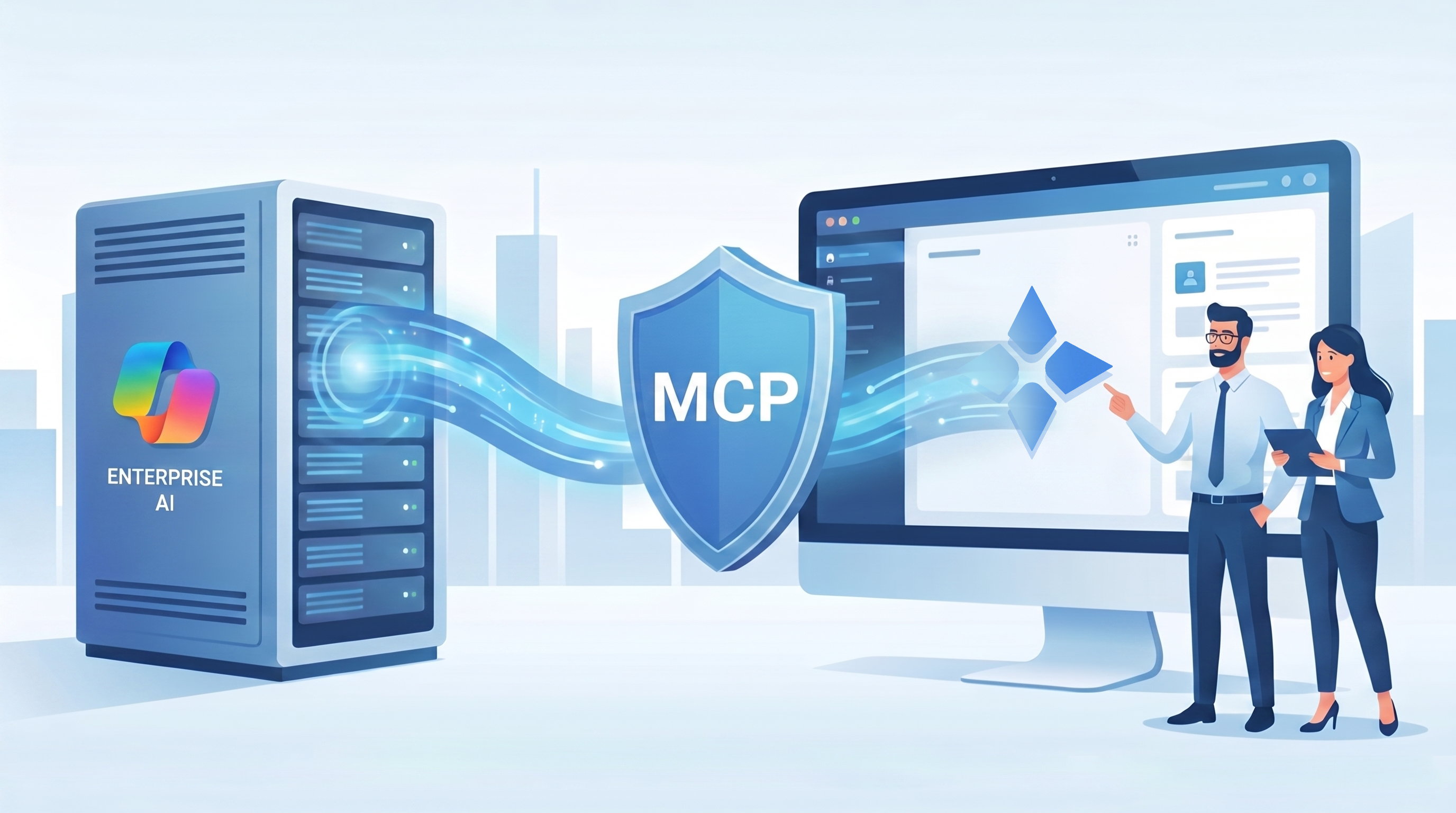
This is why we believe MCP, the Model Context Protocol, is such an important step forward.
MCP gives platforms a structured way to connect AI to business systems, tools, and data. More importantly, it allows that connection to happen without forcing every customer into the same AI provider, the same data flow, or the same governance model.
For enterprises, that matters.
Bring Your Own AI Should Be the Default
Enterprises do not adopt AI in a vacuum. They have procurement rules, data processing agreements, security reviews, internal AI policies, approved vendors, logging requirements, and sometimes strict data residency obligations.
So when a software vendor adds "AI" by hardcoding one external model provider, the customer is often forced into an awkward choice: accept a new AI vendor and all the governance work that comes with it, or disable the feature entirely.
That is not how enterprise AI should work.
With MCP, the better model is Bring Your Own AI.
If an organisation has already approved a specific LLM, deployment model, region, retention policy, and monitoring setup, the platform should respect that. The customer should be able to connect the AI environment they already trust instead of sending compliance data through a vendor-selected model.
This is especially important in GRC and security work. Compliance platforms contain sensitive material: risks, controls, policies, audit evidence, supplier details, remediation plans, internal ownership, and sometimes customer or employee-related information.
That data should not move somewhere unexpected just because someone wants help drafting a control description.
Data Control Is Not a Detail
A lot of AI conversations treat data handling as a legal footnote. In enterprise compliance, it is central.
If a team asks AI to summarise audit evidence, compare controls, or explain gaps against a framework, the prompt may contain highly sensitive operational information. Even the output can reveal internal weaknesses or remediation priorities.
For some organisations, using a hosted third-party model is perfectly acceptable. For others, it creates questions around processing location, subprocessors, retention, access, and regulatory obligations.
MCP allows a different architecture: the AI can run through the organisation's own approved setup, while the platform exposes only the tools and context that the user is allowed to access.
That distinction is critical.
The platform does not need to become the customer's AI governance exception. The customer remains in control of the model, the infrastructure, and the policies around it.
AI Should Not Create a New Usage Tax
There is also a practical adoption problem: cost.
If every useful AI action creates token anxiety or a separate vendor bill, people will hesitate to use it. That is a problem because AI is most valuable in compliance when it becomes part of everyday work.
A compliance team should be able to ask for help understanding a requirement, drafting a task, summarising evidence, comparing a control to a framework, or preparing for an audit without wondering whether they are burning through a separate AI budget.
When the enterprise brings its own AI, usage fits into the organisation's existing infrastructure, plan, and cost model. There may still be internal AI costs, of course, but they are governed by the customer, not hidden inside a platform-specific AI add-on.
That makes adoption easier and more predictable.
How We Implemented MCP in ArbaGRC
At Arba Security, we built ArbaGRC around a simple idea: compliance should become operational work, not static documentation.
Requirements become tasks. Tasks get owners. Evidence is collected. Progress is tracked. Audit readiness becomes visible. Frameworks such as ISO 27001, NIS2, CIS 18, NIST, and others become manageable day-to-day workflows.
When we added AI capabilities, we did not want AI to become a shortcut around governance. We wanted it to support governance.
That is why we implemented MCP in ArbaGRC.
Through MCP, organisations can connect their own approved AI to the platform. The AI can assist with compliance work while respecting the enterprise's existing AI decisions, data boundaries, and security model.
But the most important part is not simply connecting AI. It is controlling what the AI can access and what it can do.
ArbaGRC supports granular access control for both features and data. That means AI-assisted workflows follow the same permission logic as the user and organisation. AI does not automatically get full access just because it is connected.
Some users may only be allowed to read certain data. In that case, AI can help summarise, explain, or retrieve information, but it cannot change records. Other users may have read-and-write permissions, allowing AI to help create tasks, update documentation, suggest improvements, or support remediation workflows.
That separation matters.
In compliance, "AI can read this" and "AI can change this" are completely different risk levels. Treating them the same would be irresponsible.
The Point Is Not AI Everywhere
The goal is not to add AI for the sake of adding AI.
The goal is to make AI useful inside enterprise compliance without weakening the controls that compliance depends on.
MCP helps make that possible. It lets organisations bring their own AI, keep data under their own governance, avoid platform-specific AI cost surprises, and apply granular access control to AI-assisted work.
That is the difference between an impressive AI demo and an enterprise-ready AI architecture.
For GRC, that difference matters.